


Here are the latest news from Domaine de Leyre-Loup
How our vineyard changed…the day we changed the way we work
Domaine de Leyre-Loup expands in Chiroubles and Moulin-à-Vent
Towards regenerative viticulture
Facing Climate Challenges, Domaine de Leyre-Loup Takes Action
At Domaine de Leyre-Loup, Viticulture Is Decarbonized
Through hail... and hell
Which of these two grapes would you choose?
These two photos were taken on the same day, on the same vine row, after the hailstorm of July 16. The contrast speaks for itself.
Without protection, the berries struck by hail dry out and fall off, and the shredded leaves struggle to feed the plant. The harvest is cut in half. A hardship for the vine, and for us.
Protected by hail nets, the vine withstands both hail and extreme heat — and it shows: the clusters are better formed, the berries continue to grow despite the lack of water, in short, the vine is doing well.
In 2025, Domaine de Leyre‑Loup installed hail nets over 4 hectares of vines. Next year, we plan to cover an equivalent surface, taking our future into our own hands.
This installation was made possible thanks to the support of the Auvergne‑Rhône‑Alpes Region and the European Union. It saved part of this year’s harvest. Thank you!


How our vineyard changed…
the day we changed the way we work
About twelve years ago, we asked ourselves a simple, almost naïve question—one that ended up changing everything: what if, to help the vine grow, we started by bringing the soil back to life?
That day, something opened. We understood that the vine wasn’t the goal, but the outcome. The outcome of living soil. Of a balanced ecosystem. Of a landscape that breathes.
So we decided to change. Together.
We began by observing. Then by unlearning.
We kept the soil covered. It sounds simple… but it’s a cultural shift. Bare soil erodes. Covered soil lives.
Today, 75% of our vineyards are grass‑covered all year long. Back then, it was a gamble. Now, it’s our foundation.
And slowly, life returned.
We reduced tillage. We started making our own compost. We replaced certain mechanical operations with deep‑rooted plants. We planted hedges, installed nesting boxes.
And little by little, we saw the soil breathe again. Worms, fungi, insects… Life came back, and the vine felt it.
One day, science put numbers on what we had been experiencing, and in 2023, a study conducted with the French Wine Institute confirmed it: our soils now store carbon.
What we had been observing for years became measurable. And it gave us even more momentum.
Fewer inputs. More natural balances. Legumes fix nitrogen. Organic matter feeds the soil. Biodiversity protects the vine.
The result: fewer herbicides, fewer mineral fertilizers, fewer fungicides—and grapes that are naturally richer, harvest after harvest.
Today, we’re no longer just cultivating a vineyard. We’re cultivating an ecosystem. A living landscape. A soil that holds water better, erodes less, and withstands drought more easily. A place where the vine is no longer assisted, but supported by life itself.
And us, in all this? We’ve learned to listen. To observe. To move forward step by step.
When we take care of the soil,
the soil takes care of everything else.
Domaine de Leyre-Loup expands with new vineyard acquisitions in Chiroubles and Moulin-à-Vent
We are pleased to announce the acquisition of three new vine plots this year.
One plot in Chiroubles, located in the area known as Le Verdy, sits on a high-altitude terroir renowned for producing fine, floral, and elegant wines.
Two plots in Moulin-à-Vent, in well-ranked Lieux-dits Le Bief and Les Pinchons, are representative of this iconic appellation known for its powerful, structured wines built for aging.
Domaine de Leyre-Loup now encompasses four Beaujolais crus: Fleurie, Morgon, Moulin-à-Vent, and Chiroubles. These are crafted into two complementary styles: Domaine de Leyre-Loup wines, aged in stainless steel tanks for a pure expression of the terroir, and Réserve Louis Leyre-Loup wines, aged in 400-liter demi-muids for silky structure and refined complexity.
This range of red wines is complemented by Granits de Bellevue, the estate’s emblematic Viognier.
With this diversity of terroirs and profiles, Domaine de Leyre-Loup offers a coherent and distinctive portfolio, perfectly suited to the expectations of wine professionals and their clients as well as true enthusiasts.
Towards Regenerative Viticulture at Domaine de Leyre-Loup
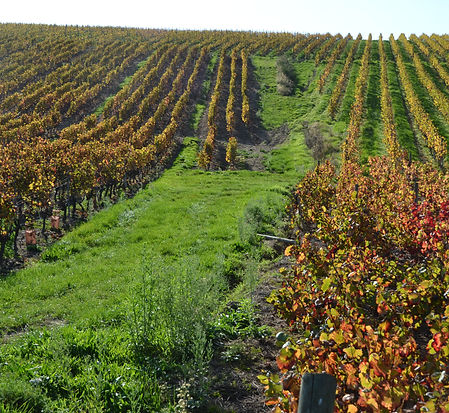
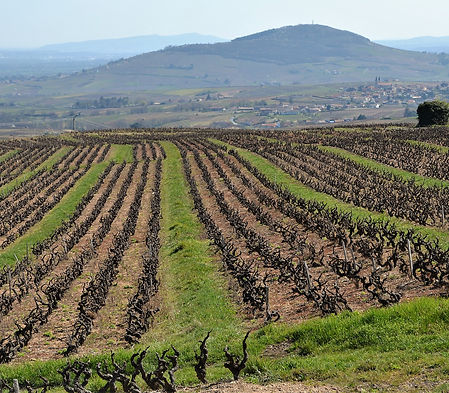
As part of our agroecological transition, we have introduced inter-row cover cropping with leguminous plants across several plots of the estate.
This plant cover plays a key role in improving soil health and vineyard resilience, delivering tangible agronomic and environmental benefits.
Natural nitrogen fixation in the soil: Through their symbiosis with rhizobia, legumes naturally enrich the soil with nitrogen, reducing the need for synthetic fertilizers. Ultimately, we aim for ecological balance without external fertilizer inputs.
Improved soil structure: Legume roots promote aeration and porosity, reducing compaction risks and stimulating biological activity.
Reduced erosion and better water infiltration: The plant cover protects the soil from heavy rainfall and enhances water retention. This is especially beneficial for our steeply sloped vineyards.
Boosted biodiversity: These species attract pollinators and beneficial insects, strengthening the vineyard’s biological balance and fostering vibrant, dynamic subsoils.
This practice is fully aligned with our goal of regenerative viticulture, which seeks to restore the soil’s natural functions and achieve balance of vine needs without human intervention.
Facing Climate Challenges, Domaine de Leyre-Loup Takes Action
In a proactive response to climate change, Domaine de Leyre-Loup has equipped 3.5 hectares of vineyards this year with anti-hail nets.
As we assess the initial results, this system proves to be highly relevant, addressing several major agronomic challenges beyond the obvious protection against hail.
Thermal stress mitigation: The partial shading provided by the nets significantly lowers the temperature beneath the canopy, helping to prevent berry sunburn and dehydration during periods of extreme heat and intense sunlight.
Plant health prevention: By reducing the wash-off of treatments due to rain and limiting contamination from splashing (spore dispersal caused by raindrop rebound on the soil), the nets help slow the spread of downy mildew and other fungal diseases.
This system has helped soften the impact of this year’s low yields and contributed to the creation of an exceptional 2025 vintage.
It is fully aligned with our strategy for viticultural resilience and our commitment to sustainable, regenerative winegrowing.


At Domaine de Leyre-Loup, Viticulture Is Decarbonized
We are pleased to share the results of an in-depth study conducted by the Rhône Chamber of Agriculture and the French Wine Institute, examining all our viticultural practices—from vine pruning to harvest.
This analysis assessed carbon storage in our vineyards; direct emissions of CO₂, methane, and nitrous oxide; and indirect emissions of these same gases related to the production of cover crop seeds, fuels, fertilizers, plant protection products, and electricity generation.
Conclusion: Our viticulture is decarbonized, with a net annual carbon storage.
This outcome is the result of over 12 years of agroecological commitment, notably through the progressive inter-row cover cropping of our plots and the on-site shredding of pruned wood, which promotes the return of organic matter to the soil.
This scientific recognition strengthens our approach to regenerative viticulture, focused on the self-sufficiency of our plots, soil life, and environmental stewardship.